Can a bondsman revoke your bond in Kansas? Yes. K.S.A. 22-2809 lets the surety on a bond arrest the person and hand them back to the county jail. Bondsmen call this a surrender, or going off the bond. A judge can end a bond too, by revoking it for a broken condition. The two are different, they start for different reasons and they are fixed in different ways. This page explains both for cases in Wichita and Sedgwick County.
Case Bail Bonds is at 705 N Broadway in Wichita. If you are worried about the status of a bond, call (316) 900-1667 and ask. A phone call is always better than silence.
On this page
- Two ways a bond ends early
- How can a bondsman revoke your bond?
- Why would a bondsman go off a bond?
- When does a judge revoke a bond?
- Do you get the premium back if the bond is revoked?
- What to do if your bond was revoked
- Frequently asked questions
- Talk to us first
Two ways a bond ends early
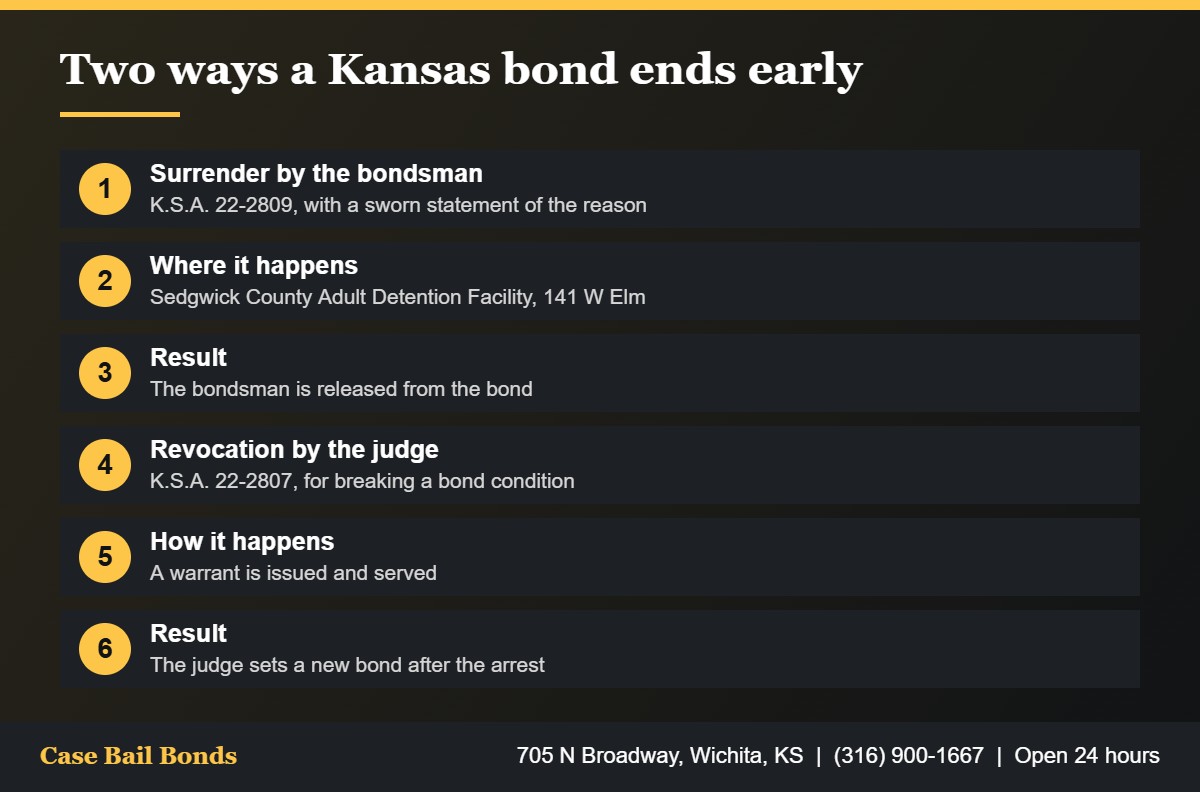
| Surrender by the bondsman | Revocation by the judge | |
|---|---|---|
| Law | K.S.A. 22-2809 | K.S.A. 22-2807 |
| Who decides | The surety that posted the bond | The court |
| Usual trigger | The bondsman no longer trusts the person to appear | A broken bond condition |
| What happens | The person is taken to the jail and the bondsman swears to the reason | A warrant is issued and served |
| What comes next | The person stays in custody until released again as the law allows | The judge promptly sets a new bond |
A third outcome, forfeiture, is something else. Under Kansas law a bond is forfeited only for a failure to appear in court. That is covered in our article on failure to appear in Kansas.
How can a bondsman revoke your bond?
The statute is short. A person released on an appearance bond may be arrested by the surety, or by someone the surety authorizes, and delivered to a custodial officer of the court in the county where the charge was filed. The custodial officer is the county sheriff or the keeper of the county jail.
The person is then brought before a judge. If the surety gives a sworn statement, written or oral, of the reasons for wanting off the bond, the judge records the surety’s discharge. The judge may commit the person, who then stays in custody until released as provided by law. In plain terms, a new bond has to be posted.
Local rules add a detail. Rule 303 of the 18th Judicial District says a defendant on a Sedgwick County case is surrendered when delivered to the Sedgwick County Adult Detention Facility at 141 W Elm. Turning someone in at a jail in another county or another state does not count. On a timely surrender, the surety is released from all further liability on the bond.
Who can make the arrest?
The bondsman, a bail agent working for the bondsman, or a licensed bail enforcement agent. K.S.A. 22-2809a sets limits:
- Before making an apprehension in Kansas, the agent must notify local law enforcement in that city or county.
- The agent must show a copy of the bond and a government photo ID.
- A bail enforcement agent must hold a Kansas license.
- A person with a felony conviction cannot work as a surety, bail agent or bail enforcement agent unless the conviction was expunged.
Our fugitive recovery in Wichita page explains that side of the business.
Why would a bondsman go off a bond?
A bondsman is on the hook for the full bond if the person does not come to court. On a $10,000 bond, that is $10,000 the company owes the court. Surrender is how a bondsman limits that risk. The common reasons:
- Lost contact. The phone is off, texts go unanswered and check ins stop.
- A move with no notice. The address on the application is empty, or the person has left Kansas without permission.
- A new arrest. A second case changes the risk.
- The cosigner asks. The person who signed for the bond tells the bondsman they no longer trust the defendant to appear. See how to get off a bond you cosigned.
- False information. A wrong address, employer or name on the application.
- Signs of running. Talk of leaving town, a sold car, a quit job.
Most surrenders can be avoided. Answer the phone, keep your check ins, tell the bondsman before you move or change numbers and show up early for court. Our list of defendant responsibilities after bail covers the rest.
When does a judge revoke a bond?
K.S.A. 22-2807 separates two things. A failure to appear leads to forfeiture. Any other violation of the bond, such as contact with a protected person, a failed drug test or a new charge, can lead to revocation. The bond is treated as revoked when the arrest warrant for the violation is served. The judge must then promptly set a new bond under K.S.A. 22-2802.
That new bond is often higher and can come with tighter conditions. The premium paid on the first bond does not carry over.
Do you get the premium back if the bond is revoked?
Kansas statutes do not promise a refund of the premium after a surrender or a revocation. What you get back depends on the contract you signed, so read that section before you sign and ask the bondsman to explain it.
Collateral is different. K.S.A. 22-2809b lists intentionally failing to return collateral when it is due as a ground for a court to suspend or end a bondsman’s authority to write bonds. Once the bond is discharged and nothing is owed, collateral has to come back. See bail bond collateral in Kansas.
What to do if your bond was revoked
- Find out which kind it was. A surrender by the bondsman and a revocation by the judge are fixed differently.
- Check the jail record. The Sedgwick County inmate search shows whether a new bond amount is set. If it shows none, read what no bond means.
- Call a lawyer. After a judge’s revocation, a lawyer can argue for a reasonable new bond.
- Call a bondsman. After a surrender the person can be bonded again, by the same company or a different one, if someone will write it. Expect a new premium.
Frequently asked questions
How would you know if your bond is revoked?
Often you find out when you are arrested. The court does not have to warn you. If you think a condition was broken or a court date was missed, call your lawyer and your bondsman that day.
Can the person who paid your bond revoke it?
Not directly. Only the surety or the judge can end the bond. A cosigner can ask the bondsman to surrender the defendant, and the bondsman decides.
How long do you stay in jail if your bond is revoked?
Until a new bond is set and posted, or until the case ends. After a judge’s revocation, the statute requires the new bond to be set promptly.
Can a bondsman come into my home?
Kansas law requires agents to notify local law enforcement before an apprehension and to carry the bond and ID. Questions about entry in a specific case are for a lawyer.
Can a bondsman revoke a bond over missed payments?
That depends on the contract. Ask before you sign, and call before you miss a payment. Ask about changing the payment plan before a payment is late.
Talk to us first
Case Bail Bonds is family owned and run by Tyson and Rachel Case, both from Wichita. We are open 24 hours at 705 N Broadway, Wichita, KS 67214. Call (316) 900-1667.
Sources
- K.S.A. 22-2809, surrender of obligor by surety, Kansas Office of Revisor of Statutes
- K.S.A. 22-2809a, sureties, bail agents and bail enforcement agents
- K.S.A. 22-2807, forfeiture and revocation of appearance bonds
- K.S.A. 22-2809b, compensated sureties
- 18th Judicial District Court, local court rules, Rule 303
This article is general information checked against the sources above in October 2026. It is not legal advice.