Kansas felony severity levels rank every felony from level 1, the most serious, to level 10, the least. Drug felonies have their own scale of 1 to 5. A judge finds the sentence by looking up the severity level on one side of a chart called the sentencing grid and the person’s criminal history on the other. The level also affects bond, because a judge setting bond looks at how much prison time the person faces. This page explains the levels with real numbers from the grid.
Case Bail Bonds posts felony bonds every day at the Sedgwick County Jail. We are at 705 N Broadway in Wichita. Call (316) 900-1667.
On this page
- How the Kansas sentencing grid works
- Kansas felony severity levels and prison ranges
- Prison or probation?
- The 9 criminal history categories
- The drug grid
- Off grid and nongrid crimes
- How does the severity level affect bond?
- Where do I find the severity level of a charge?
- Frequently asked questions
- Need a felony bond posted?
How the Kansas sentencing grid works
The grid is set out in K.S.A. 21-6804. Think of it as a table.
- Rows are severity levels 1 through 10.
- Columns are criminal history categories A through I.
- Each box holds three numbers, in months: a high, a middle and a low. The Sedgwick County District Attorney explains that the middle number is the presumptive prison term and the other two are the range the judge can use without a departure.
The judge must impose the grid sentence unless there are substantial and compelling reasons to depart from it.
Kansas also labels every felony as person or nonperson. Person felonies are crimes against people, such as robbery. Nonperson felonies are crimes against property or public order, such as theft and forgery. The label matters most when counting criminal history.
Kansas felony severity levels and prison ranges
These ranges come from the sentencing grid published by the Sedgwick County District Attorney. The first column of numbers is for a person with no record or one misdemeanor. The second is for a person with three or more prior person felonies.
| Severity level | No prior record | Three or more person felonies | Probation term | Supervision after prison |
|---|---|---|---|---|
| 1 | 147 to 165 months | 592 to 653 months | 36 months | 36 months |
| 3 | 55 to 61 months | 221 to 247 months | 36 months | 36 months |
| 5 | 31 to 34 months | 122 to 136 months | 36 months | 24 months |
| 7 | 11 to 13 months | 30 to 34 months | 24 months | 12 months |
| 8 | 7 to 9 months | 19 to 23 months | Up to 18 months | 12 months |
| 9 | 5 to 7 months | 15 to 17 months | Up to 12 months | 12 months |
| 10 | 5 to 7 months | 11 to 13 months | Up to 12 months | 12 months |
The same crime can mean very different time. A level 7 felony is about one year for a first offense and close to three years for a person with a long record.
Prison or probation?
The grid is split by a line.
- Presumptive prison. Boxes above the line. Levels 1 through 4 are prison for everyone.
- Presumptive probation. Boxes below the line. A first offense at levels 7 through 10 falls here. The numbers in the box still matter, because that is the prison term that hangs over the person if probation is revoked.
- Border boxes. K.S.A. 21-6804 names three: 5-H, 5-I and 6-G. Prison is presumed, but the judge may order probation with treatment without it counting as a departure.
Special rules can override the box. Using a firearm to commit a person felony makes prison the presumption. A new felony committed while on bond for another felony lets the judge order prison even where the grid says probation. We cover that in arrested again while on bond.
The 9 criminal history categories
K.S.A. 21-6809 defines the columns. A is the worst record and I is the cleanest.
| Category | Prior record |
|---|---|
| A | Three or more person felonies |
| B | Two person felonies |
| C | One person felony and at least one nonperson felony |
| D | One person felony |
| E | Three or more nonperson felonies |
| F | Two nonperson felonies |
| G | One nonperson felony |
| H | Two or more misdemeanors |
| I | One misdemeanor or no record |
Juvenile adjudications count along with adult convictions. Out of state convictions count too.
The drug grid
Drug felonies use a separate grid with five levels.
| Drug severity level | No prior record | Three or more person felonies |
|---|---|---|
| 1 | 138 to 154 months | 185 to 204 months |
| 2 | 92 to 103 months | 130 to 144 months |
| 3 | 46 to 51 months | 74 to 83 months |
| 4 | 14 to 16 months | 46 to 51 months |
| 5 | 10 to 12 months | 37 to 42 months |
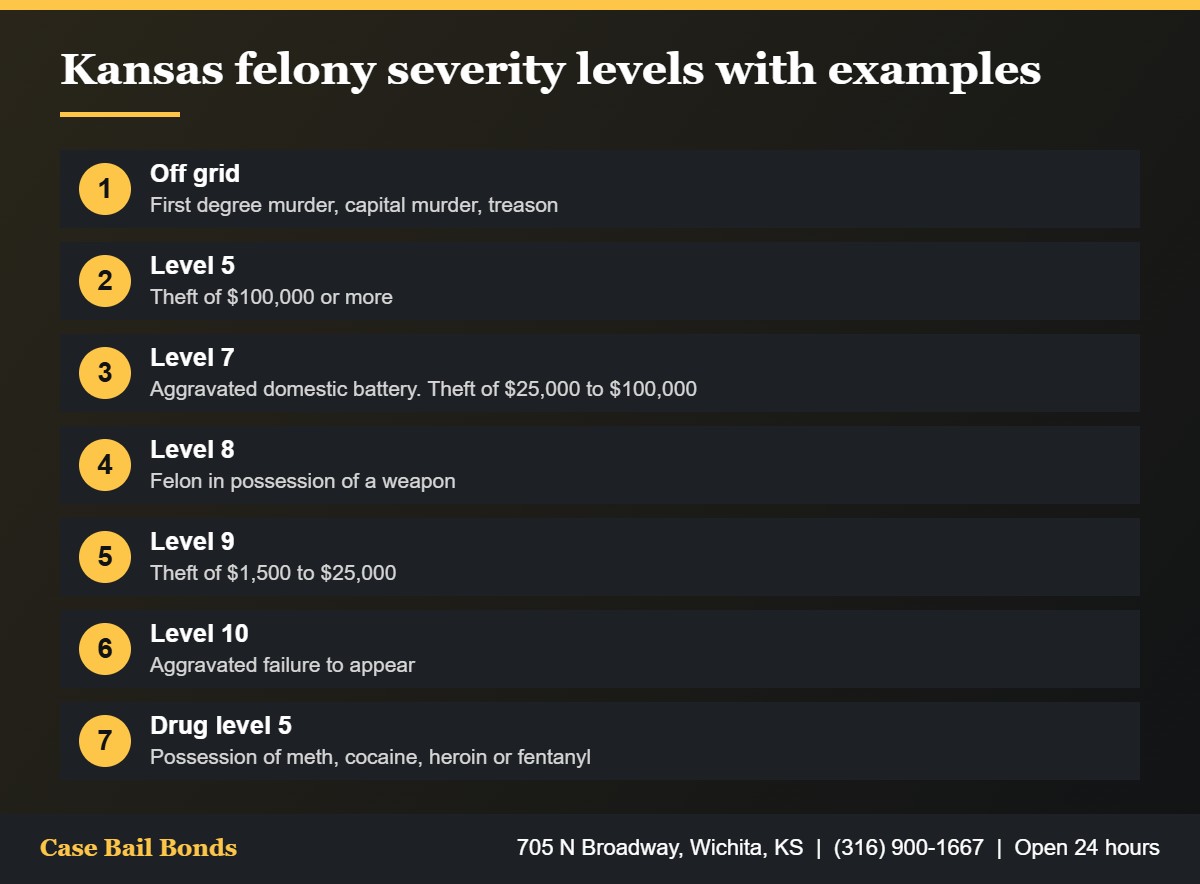
Simple possession of methamphetamine, cocaine, heroin or fentanyl is a drug severity level 5 felony. Many people at that level qualify for treatment in place of prison under K.S.A. 21-6824. See drug possession bail bonds in Wichita.
Off grid and nongrid crimes
Two groups sit outside the grids.
- Off grid crimes. The District Attorney lists treason, first degree murder and capital murder. Their penalties are set by other statutes.
- Nongrid crimes. These are felonies punished with county jail time and not prison. Felony DUI is the usual example.
How does the severity level affect bond?
Kansas does not set bond by a statewide chart. K.S.A. 22-2802 tells the judge to weigh the nature of the charge, the weight of the evidence, criminal record, past court appearances and ties to the community. The severity level feeds into the first factor. The criminal history category feeds into the third.
In practice:
- Levels 7 to 10, clean record. Lower bonds, and sometimes release on a signature. See OR bond in Sedgwick County.
- Levels 4 to 6. Higher bonds, often with supervision or GPS monitoring.
- Levels 1 to 3 and off grid. The highest bonds. The Sedgwick County District Attorney also excludes levels 1, 2 and 3 from adult diversion.
Whatever the amount, a bondsman’s premium is at least 10% under K.S.A. 22-2809b. Our page on felony bail bonds in Wichita walks through the process, and Kansas bail bond laws covers the rules.
Where do I find the severity level of a charge?
- The complaint. The charging document lists the statute and the level for each count.
- The statute. Every Kansas crime states its own level. Theft, for example, is level 9 at $1,500, level 7 at $25,000 and level 5 at $100,000.
- Your lawyer. The level can change with the facts, such as a prior conviction or the use of a weapon.
Frequently asked questions
What is the lowest felony in Kansas?
Severity level 10 on the nondrug grid and level 5 on the drug grid. Aggravated failure to appear is a level 10 felony.
What is a level 9 felony in Kansas?
A low level felony with a prison range of 5 to 7 months for a person with no record, and probation presumed for a first offense. Theft of $1,500 to $25,000 is one example.
Is a severity level 1 felony the worst?
It is the highest level on the grid. Off grid crimes such as first degree murder are more serious still.
Does a felony always mean prison in Kansas?
No. A first offense at levels 7 through 10 falls in the presumptive probation part of the grid.
Can a felony be removed from my record?
Many can, after a waiting period. See expungement in Wichita.
Need a felony bond posted?
Case Bail Bonds is family owned and run by Tyson and Rachel Case. Call (316) 900-1667 or visit 705 N Broadway, Wichita, KS 67214.
Sources
- K.S.A. 21-6804, sentencing grid for nondrug crimes, Kansas Office of Revisor of Statutes
- K.S.A. 21-6809, criminal history categories
- Sedgwick County District Attorney, sentencing guidelines
- Sedgwick County District Attorney, sentencing grid (PDF)
- K.S.A. 22-2802, release before trial
This article is general information checked against the sources above in October 2026. Grid numbers can change, so confirm the current grid with a lawyer. It is not legal advice.