Kansas bail bond laws are found mostly in Chapter 22, Article 28 of the Kansas Statutes. They say who has a right to bail, how a judge sets the amount, what a bondsman must charge, and what happens when someone misses court. The Legislature changed several of these rules in 2024 and again in 2025. This page puts the current rules in plain English, with the statute number for each one so you can read it yourself.
Case Bail Bonds works under these laws every day at 705 N Broadway in Wichita, three blocks from the Sedgwick County Jail. Call (316) 900-1667 with questions about a specific bond.
On this page
- The 9 rules at a glance
- 1. The right to bail
- 2. How a judge sets the bond
- 3. Four ways to post a bond under Kansas law
- 4. What a bondsman must charge
- 5. Who is allowed to write bonds
- 6. Forfeiture: what happens after a missed court date
- 7. Surrender by the bondsman
- 8. Bail enforcement agents
- 9. Failure to appear as a crime
- What changed in 2024 and 2025?
- Do city courts follow the same rules?
- Frequently asked questions
- Questions about a bond in Wichita?
The 9 rules at a glance
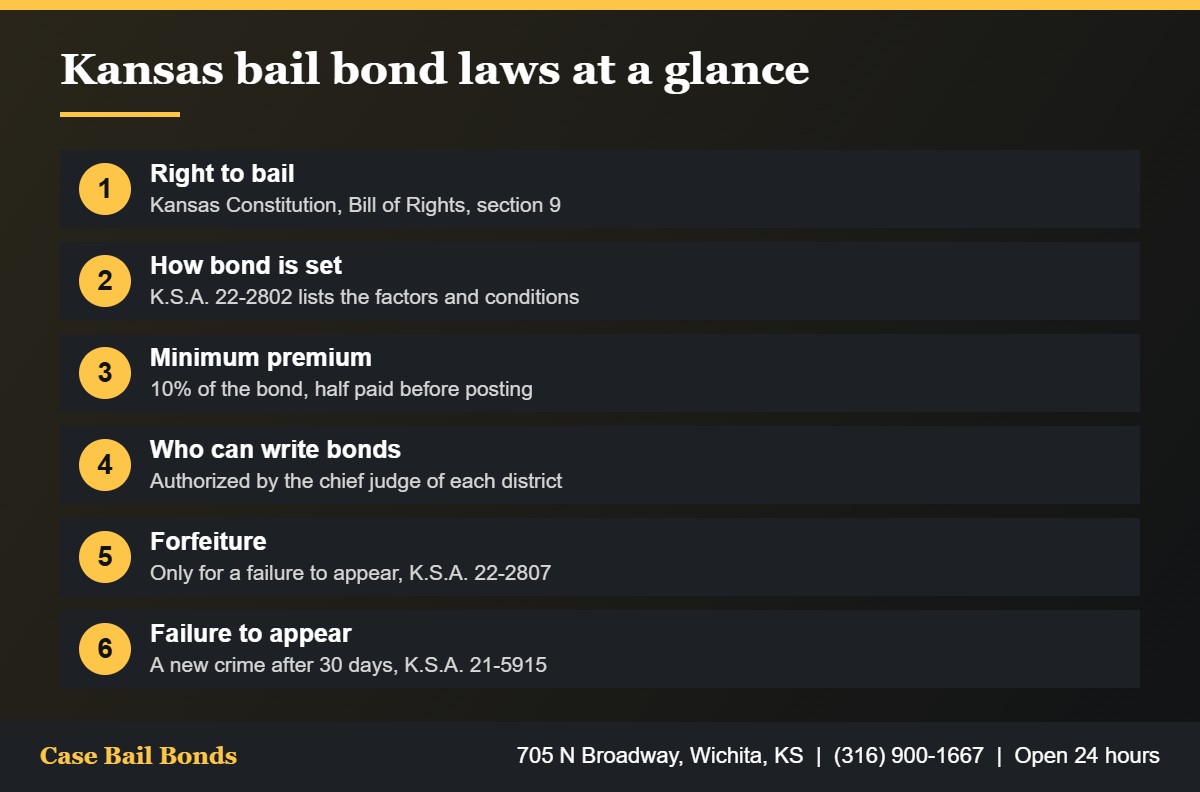
Each rule below has its statute number. The sections are short on purpose.
1. The right to bail
Section 9 of the Kansas Bill of Rights says all persons shall be bailable by sufficient sureties, except for capital offenses where the proof is evident or the presumption great. It also bars excessive bail. K.S.A. 22-2802 carries that out: a person charged with a crime must be ordered released at the first appearance on a bond high enough to assure they return to court and that the public is safe.
2. How a judge sets the bond
K.S.A. 22-2802 lists what the judge weighs: the nature of the charge, the weight of the evidence, family ties, employment, financial resources, character, mental condition, length of residence, criminal record, past court appearances and the risk of new offenses or threats to witnesses.
The judge can add conditions, including travel limits, house arrest, supervision by a court services officer at up to $15 a week and, on a felony, a drug and alcohol evaluation. On a person felony or person misdemeanor, the bond must bar contact with the alleged victim for at least 72 hours unless the judge finds otherwise. Every condition has to be written on the bond.
A person who stays in jail can ask for the conditions to be reviewed, and the court must do it without unnecessary delay.
3. Four ways to post a bond under Kansas law
| Type | How it works | What comes back |
|---|---|---|
| Surety bond | A Kansas resident surety, usually a licensed bondsman, guarantees the bond | Nothing. The premium is the fee |
| Cash bond | The full amount is deposited with the court | All of it after the case, minus restitution, costs, fines and fees |
| 10% cash deposit with the clerk | A judge may allow it on bonds of $2,500 or less for Kansas residents with little or no record | The deposit, on the same terms |
| Own recognizance | A signed promise to appear, with no money down | Nothing is paid |
Two details protect families. A court may not rule out the surety bond option, and a court may not charge an administrative fee for a bond. For the local version of signature release, see OR bond in Sedgwick County.
4. What a bondsman must charge
This is the rule people ask about most. Under K.S.A. 22-2809b:
- The minimum premium is 10% of the face amount of the bond.
- At least half of that minimum must be received before the bond is posted.
- Accepted payment is cash, a check, a credit or debit card with an approval number, or a completed bank or electronic transfer.
- Any unpaid part of the minimum must be covered by a written premium financing agreement.
- The bondsman may not lend you the half that is due up front, and may not own or be tied to a lender that does.
- The bondsman must be physically present at the jail and sign the bond there.
So a company that advertises 5% down is describing the up front half of a 10% premium, not a cheaper bond. On a $10,000 bond the legal floor is $1,000, with $500 paid first. See bail bond payment plans in Wichita.
5. Who is allowed to write bonds
A bondsman cannot work in a county just by opening an office. K.S.A. 22-2809b requires each compensated surety to apply to the chief judge of every judicial district where it wants to write bonds. The applicant must be a Kansas resident with no felony conviction that has not been expunged, and must complete 8 hours of continuing education every 12 months.
In Wichita that means approval under Rule 303 of the 18th Judicial District Court. Authorization runs from July 1 to June 30 and has to be renewed every year.
The same statute lists conduct that can cost a bondsman that authorization: charging less than the minimum premium, paying inmates for referrals, giving anything of value to jail staff or officers, demanding anything beyond the premium other than collateral, and intentionally failing to return collateral when it is due.
6. Forfeiture: what happens after a missed court date
K.S.A. 22-2807 is strict about the word. A bond is forfeited only for a failure to appear. Other violations lead to revocation and a new bond.
| Event | Deadline in the statute |
|---|---|
| Court declares forfeiture and issues a warrant | At the missed appearance |
| Sheriff enters a felony warrant into the national index | Within 14 days |
| Earliest judgment against the surety | More than 60 days after notice |
| Latest judgment | Two years after the failure to appear |
| Refund if the person is returned after judgment | 90% within 90 days, 75% by 180 days, 50% by 270 days |
A court must set a forfeiture aside in certain cases, such as proof that the person was in jail elsewhere in the United States. More in failure to appear in Kansas.
7. Surrender by the bondsman
K.S.A. 22-2809 lets a surety arrest a person on bond and deliver them to the county jail, then give a judge a sworn statement of the reason. The surety is then discharged. We explain it in can a bondsman revoke your bond.
8. Bail enforcement agents
Under K.S.A. 22-2809a, a bail enforcement agent must be licensed in Kansas, must notify local law enforcement before an apprehension and must carry the bond and photo ID. A first violation is a class A misdemeanor.
9. Failure to appear as a crime
Under K.S.A. 21-5915, a person who forfeits a bond and does not surrender within 30 days commits failure to appear, a class B misdemeanor. If the underlying charge is a felony, it is aggravated failure to appear, a severity level 10 felony.
What changed in 2024 and 2025?
- 2024, Senate Bill 473. Became law after a veto override. It required a minimum bond premium in district court and added reasons a court can suspend or end a compensated surety’s authorization.
- 2025, Senate Bill 186. Approved April 24, 2025. It set a minimum bond of $750,000 for people charged with certain sex crimes who have a prior sexually violent conviction, revised the grounds for setting aside a forfeiture, and barred sureties from lending the up front part of the premium.
Do city courts follow the same rules?
Not exactly. Municipal courts have their own code. K.S.A. 12-4213 requires bond to be set within 18 hours of custody. See the Wichita Municipal Court bond guide.
Frequently asked questions
Is 10% bail required by law in Kansas?
Yes. 10% is the minimum premium a compensated surety may charge.
Do you get bail bond money back in Kansas?
Cash posted with the court comes back after the case, less costs and fines. A premium paid to a bondsman does not.
What rights does a bail bondsman have?
To surrender a defendant under K.S.A. 22-2809 and to collect what the contract allows. Not to charge fees beyond the premium and collateral.
Questions about a bond in Wichita?
Case Bail Bonds is family owned and run by Tyson and Rachel Case, at 705 N Broadway, Wichita, KS 67214. Call (316) 900-1667, 24 hours a day.
Sources
- K.S.A. 22-2802, release before trial, Kansas Office of Revisor of Statutes
- K.S.A. 22-2807, forfeiture of appearance bonds
- K.S.A. 22-2809b, compensated sureties
- K.S.A. 22-2809a, bail enforcement agents
- 2024 Senate Bill 473, Kansas Legislature
- 2025 Session Laws of Kansas, chapter 120 (SB 186), Kansas Secretary of State
This article is general information checked against the sources above in October 2026. It is not legal advice.