Weapons charge bail bonds in Wichita cover a wide range of cases, from a class A misdemeanor for carrying a prohibited item to a felony for possessing a firearm after a conviction. Kansas lets most adults carry a gun without a permit, so a weapons charge here usually turns on who the person is or what else was going on, not on the gun alone. The statute and the level of the charge drive the bond. This page explains the three Kansas laws behind most of these arrests and how release works in Sedgwick County.
Case Bail Bonds is at 705 N Broadway, three blocks from the jail at 141 W Elm. Call (316) 900-1667 at any hour.
On this page
- The 3 Kansas statutes behind most weapons charges
- When the gun is part of another crime
- How is bond set on a weapons charge?
- What does the bond cost?
- Conditions to expect after release
- Frequently asked questions
- Call Case Bail Bonds
The 3 Kansas statutes behind most weapons charges
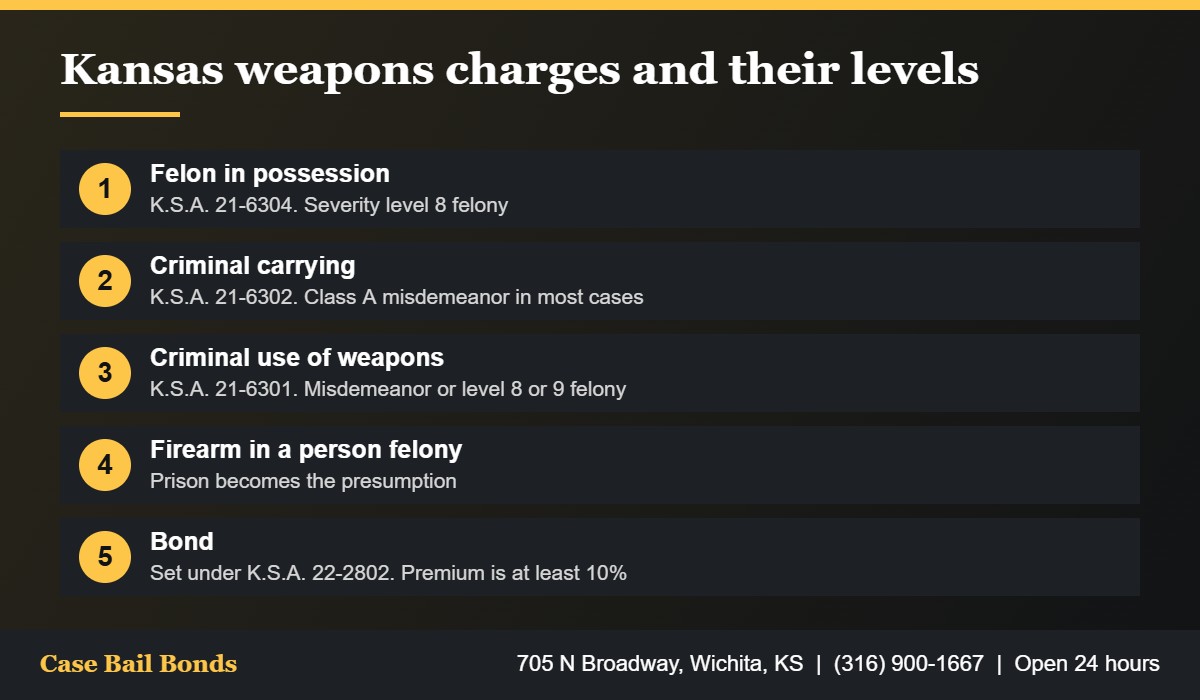
1. Criminal possession of a weapon by a convicted felon, K.S.A. 21-6304
This is the charge with the most at stake. It is a severity level 8 nonperson felony, and under the statute a weapon means a firearm or a knife. How long the ban lasts depends on the prior conviction.
| Prior conviction | How long possession is barred |
|---|---|
| Person felony where a firearm was used | No time limit |
| Person felony with no firearm finding | A set number of years after the sentence or supervision ends |
| Listed felonies, including certain drug, weapons, sex and theft related offenses | Eight years after the sentence or supervision ends |
| Other nonperson felonies | A short period after the sentence or supervision ends |
The periods are technical, and an expungement or pardon changes the answer for some groups and not others. A defense lawyer should read the prior case before anyone assumes the ban has expired.
2. Criminal carrying of a weapon, K.S.A. 21-6302
| Conduct | Level |
|---|---|
| Carrying a bludgeon, sandclub, metal knuckles or throwing star | Class A misdemeanor |
| Carrying a concealed billy, blackjack or similar dangerous weapon | Class A misdemeanor |
| Carrying a concealed firearm while under 21, with exceptions for a person’s own home, land or business and for certain license holders | Class A misdemeanor |
| Carrying a shotgun with a barrel under 18 inches, or an automatic firearm | Severity level 9 felony |
3. Criminal use of weapons, K.S.A. 21-6301
This statute has a long list. Several entries are about a person’s status.
| Conduct | Level |
|---|---|
| Possessing a firearm while addicted to and an unlawful user of a controlled substance | Class B misdemeanor |
| Possessing a firearm on school property | Class B misdemeanor |
| Possessing a firearm while a fugitive from justice | Severity level 8 felony |
| Possessing a firearm while subject to a qualifying protective order | Severity level 8 felony |
| Possessing a firearm within five years of a domestic violence misdemeanor conviction | Severity level 8 felony |
| Possessing a silencer, a short barreled shotgun or an automatic firearm | Severity level 9 felony |
Two of those tie directly to other cases on this site. A domestic battery conviction in a city court can become the basis for a felony gun charge years later. See domestic violence bail bonds in Wichita.
When the gun is part of another crime
Often the weapon is not a separate charge. It changes the main one. Under the Kansas sentencing statute, K.S.A. 21-6804, using a firearm to commit a person felony makes prison the presumed sentence, even in a grid box that would otherwise mean probation. Firing into an occupied home or vehicle adds 60 months, and 120 months if a child under 14 was present.
Judges know those numbers when they set bond. The more time a person faces, the more a court worries about flight. For how the levels work, see Kansas felony severity levels.
How is bond set on a weapons charge?
K.S.A. 22-2802 gives the judge the same list as on any charge: the nature of the offense, the weight of the evidence, family ties, employment, financial resources, criminal record, the record of appearing in court and the risk to victims, witnesses and the community.
On weapons cases, three of those carry extra weight:
- Criminal record. A felon in possession charge means there is a prior felony by definition.
- Risk to others. A gun connected to a threat or a domestic dispute is treated very differently from a gun found in a glove box during a traffic stop.
- Other open cases. A new weapons arrest while on bond or probation brings a second set of problems. See arrested again while on bond in Kansas.
Misdemeanor carrying cases written under a Wichita ordinance go to Municipal Court at 455 N Main. Felonies go to District Court at 525 N Main. See felony bail bonds in Wichita and the first appearance in Sedgwick County.
What does the bond cost?
Kansas law sets the minimum bondsman premium at 10% of the bond, with at least half of that paid before the bond is posted.
| Bond | Minimum premium | Minimum due before posting |
|---|---|---|
| $2,500 | $250 | $125 |
| $10,000 | $1,000 | $500 |
| $25,000 | $2,500 | $1,250 |
| $50,000 | $5,000 | $2,500 |
| $100,000 | $10,000 | $5,000 |
On higher bonds a bondsman may ask for a cosigner and collateral. The full table is in how much a bond costs in Kansas. If the amount is out of reach, a lawyer can ask the judge to review it. See bond reduction in Sedgwick County.
Conditions to expect after release
A judge can add any condition reasonably needed under K.S.A. 22-2802. On weapons charges, plan for these:
- No firearms or other weapons. If there are guns in the home, ask your lawyer where they can lawfully be kept while the case is pending. Do this before release, not after.
- No contact with a named person, for at least 72 hours on a person crime and often longer.
- GPS monitoring or house arrest. See GPS ankle monitor as a bond condition.
- Supervision. See Sedgwick County pretrial services.
A firearm found while a no weapons condition is in force is a bond violation, and for a person with a felony record it is also a new felony charge. The first bond can be revoked under K.S.A. 22-2807.
Federal law has its own firearm rules for people facing felony charges and for people with certain convictions. Ask a defense attorney how they apply to you.
Frequently asked questions
Is carrying a gun without a permit a crime in Kansas?
Not for most adults 21 and older. The carrying statute targets specific weapons, concealed firearms carried by people under 21 and certain prohibited firearms.
Is felon in possession of a firearm a felony in Kansas?
Yes. It is a severity level 8 nonperson felony under K.S.A. 21-6304.
Does a knife count?
For the felon in possession statute, yes. It defines a weapon as a firearm or a knife.
Will I get my gun back after posting bond?
Not while it is evidence. Whether it is returned at the end depends on the outcome of the case. Ask your attorney.
Can someone on bond for another charge keep guns at home?
Read the bond conditions. Some bar weapons outright.
Call Case Bail Bonds
We are a family owned company run by Tyson and Rachel Case. We are open 24 hours at 705 N Broadway, Wichita, KS 67214. Call (316) 900-1667.
Sources
- K.S.A. 21-6304, criminal possession of a weapon by a convicted felon, Kansas Office of Revisor of Statutes
- K.S.A. 21-6302, criminal carrying of a weapon
- K.S.A. 21-6301, criminal use of weapons
- K.S.A. 22-2802, release before trial
- K.S.A. 22-2809b, compensated sureties
This article is general information checked against the sources above in October 2026. It is not legal advice.