
A preliminary hearing in Kansas is the hearing where a judge decides whether a felony case is strong enough to go forward. Kansas law, K.S.A. 22-2902, says it must be held within 14 days after the arrest or the defendant’s personal appearance, unless it is continued for good cause. The judge does not decide guilt. The only question is probable cause. For a family, the hearing matters for two reasons: the case can end there, and the bond can be argued again.
Case Bail Bonds is at 705 N Broadway in Wichita, a few blocks from the Sedgwick County Courthouse. Call (316) 900-1667 with any question about a bond.
On this page
- Who gets a preliminary hearing?
- Where it falls in a felony case
- What happens at a preliminary hearing in Kansas?
- Why would someone waive it?
- What does the 14 day rule mean in practice?
- What happens to the bond?
- How to get ready for the hearing
- Frequently asked questions
- Need a bond before the hearing?
Who gets a preliminary hearing?
Every person charged with a felony, and the State, has a right to one. There are two exceptions in practice:
- Indictment. If a grand jury issued the charge, there is no preliminary hearing.
- Misdemeanors. The right in K.S.A. 22-2902 applies to felonies only.
So a DUI in Wichita Municipal Court or a misdemeanor theft does not get this hearing. A felony theft, a felony drug charge or an aggravated battery does. For the levels, see Kansas felony severity levels.
Where it falls in a felony case
| Stage | What happens | Timing |
|---|---|---|
| First appearance | Charges are read and bond is set | Without unnecessary delay after arrest |
| Preliminary hearing | Judge decides probable cause | Within 14 days unless continued |
| Arraignment | The plea is entered | The next required court day after being bound over, unless continued |
| Pretrial and trial | Motions, plea talks, trial | Set by the trial judge |
Our guide to the first appearance in Sedgwick County covers the step before this one.
What happens at a preliminary hearing in Kansas?
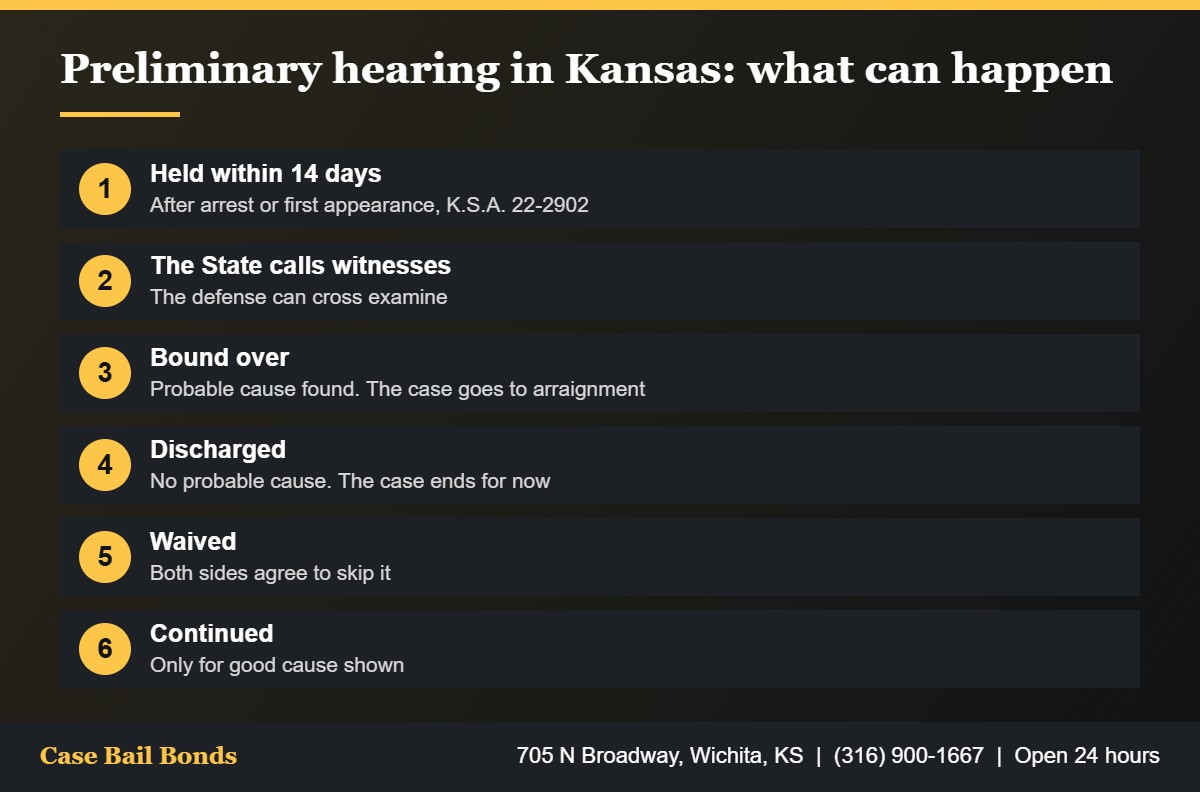
The statute sets the rules.
- The defendant must be there in person. No plea is entered at this hearing.
- The State presents witnesses. They testify in front of the defendant.
- The defense can cross examine and can present evidence of its own.
- Testimony by video is allowed. Either side may present a witness by two way audio and video.
- Child victims are treated differently. When the victim is under 13, probable cause can rest on hearsay, including a recorded statement.
Then the judge rules.
| Ruling | Meaning |
|---|---|
| Bound over | The evidence shows a felony was committed and there is probable cause the defendant committed it. The case moves to the trial court |
| Discharged | The evidence falls short. The defendant is released on that charge |
| Bound over on some counts | Common in cases with several charges |
Probable cause is a low bar. It is far below proof beyond a reasonable doubt, and many cases are bound over. A discharge is also not always final, since prosecutors can sometimes file again.
Why would someone waive it?
If the defendant and the State both waive the hearing, the judge binds the case over without testimony. Defense lawyers waive for reasons that have nothing to do with giving up:
- A plea agreement is already in place, and part of the deal is waiving the hearing.
- The lawyer does not want the State’s witnesses to lock in their testimony.
- The evidence on probable cause is not in doubt.
Lawyers also choose to hold the hearing for good reasons. It is a chance to hear the witnesses under oath, test the case and sometimes get a count thrown out. This is a decision to make with a defense attorney, not alone.
What does the 14 day rule mean in practice?
The clock starts at the arrest or the first personal appearance. Continuances may be granted only for good cause shown. In real cases, hearings are often continued, many times at the request of the defense, which needs time to get police reports and prepare.
For a person in custody, each continuance is more time at 141 W Elm. That is one reason bond matters so much on a felony. A person who is out on bond can agree to a continuance without sitting in jail for it.
In Sedgwick County, Rule 302 of the 18th Judicial District covers the preliminary hearing docket. Hearings are held at the courthouse, 525 N Main. The court posts its daily dockets online and updates them every 15 minutes, so you can confirm the room the morning of court.
What happens to the bond?
Nothing changes automatically. K.S.A. 22-2802 says a felony bond also requires the person to appear in district court after being bound over. The same bond carries through.
Three things can change it:
| Event | Effect on the bond |
|---|---|
| Bound over | Bond continues. Appear at arraignment |
| Discharged on all counts | The case is closed, and the bond ends when the court releases it |
| Bond motion granted | The judge raises, lowers or changes the conditions |
Rule 302 says the preliminary hearing judge may hear bond motions. So this is a natural point for a defense lawyer to ask for a lower bond or for release on a signature, with new facts: a job, a lease, a treatment bed, a record of making every court date so far. K.S.A. 22-2802 lets a judge amend release conditions at any time. Our page on the OR bond in Sedgwick County explains signature release.
If the case is discharged, a premium already paid to a bondsman is not refunded, and cash posted with the court is. See what happens to bail money when charges are dropped.
How to get ready for the hearing
- Know the date, time and room. It is on the bond paperwork and the court’s docket. Call the clerk at 316-660-5900 if you are unsure.
- Meet with your lawyer before that morning. Decide together whether to hold the hearing or waive it.
- Arrive early. Everyone goes through security at 525 N Main.
- Say nothing about the facts in the hallway. Witnesses and officers are standing in the same hall.
- Bring proof for a bond motion if your lawyer plans one: pay stubs, a lease, a letter from an employer.
- Do not miss it. The defendant has to be present. A missed felony court date means a forfeited bond, a warrant and possibly a new felony. Read failure to appear in Kansas.
Frequently asked questions
Is a preliminary hearing a trial?
No. There is no jury and no verdict. The judge decides only whether there is probable cause.
Can charges be dropped at a preliminary hearing?
Yes. If the evidence does not show probable cause, the judge discharges the defendant on that charge.
Do I have to testify?
No. The defendant has the right to remain silent. Defendants rarely testify at this stage.
What happens after being bound over in Kansas?
Arraignment. K.S.A. 22-3206 says it is held no later than the next required court day after the order binding the defendant over, unless it is continued.
Can family attend?
Courtrooms are generally open to the public. Sit quietly and do not speak to witnesses.
Is there a preliminary hearing on a probation violation?
No. That is a different hearing. See probation violation bail bonds in Wichita.
Need a bond before the hearing?
Case Bail Bonds is family owned and run by Tyson and Rachel Case. We are open 24 hours at 705 N Broadway, Wichita, KS 67214. Call (316) 900-1667. For how felony bonds are set, read felony bail bonds in Wichita.
Sources
- K.S.A. 22-2902, preliminary examination, Kansas Office of Revisor of Statutes
- K.S.A. 22-3206, time of arraignment
- K.S.A. 22-2802, release before trial
- 18th Judicial District Court, local court rules
- 18th Judicial District Court, docket information
This article is general information checked against the sources above in October 2026. It is not legal advice.