Release to treatment is a bond condition a Kansas judge can order when drugs or alcohol are behind the arrest. In place of waiting in the Sedgwick County Jail, the person is released to a treatment program or a sober living house and has to stay there, follow its rules and come to court. A specific plan gives a judge more to work with. This page explains what the law allows, what a plan needs and what happens if the person walks out.
Case Bail Bonds is at 705 N Broadway in Wichita, three blocks from the jail. Call (316) 900-1667. We keep local lists of sober living houses in Wichita.
On this page
- What Kansas law allows
- When does a judge consider release to treatment?
- The 5 parts of a plan
- What a sober living house expects
- What happens if the person leaves treatment?
- Treatment after the case, not just before it
- For families
- Frequently asked questions
- Call Case Bail Bonds
What Kansas law allows
K.S.A. 22-2802 gives a judge several tools that fit treatment.
| Tool in the statute | How it is used |
|---|---|
| Custody of a designated person or organization that agrees to supervise | Release to a treatment program, a sober living house or a family member |
| Restrictions on travel, association and place of abode | An order to live at a named address and stay away from named people |
| Drug and alcohol abuse examination and evaluation | Allowed as a condition for any person charged with a felony. Treatment can follow from the findings |
| Any other condition reasonably necessary to assure appearance | Testing, curfew, meetings |
| House arrest or supervision by a court services officer | Added when the judge wants closer monitoring |
Every condition has to be written on the appearance bond. The statute also lets a judge amend conditions at any time, so a plan can be presented at the first appearance or weeks later.
One limit is worth knowing. The court run supervised release program in K.S.A. 22-2816 does not take people who need treatment for chemical dependency. Treatment as a bond condition comes from the judge’s order under K.S.A. 22-2802, not from that program.
When does a judge consider release to treatment?
- At the first appearance, if a lawyer or family member has a plan ready. See first appearance in Sedgwick County.
- On a bond motion, when the first bond was too high to post. See bond reduction in Sedgwick County.
- After a violation, such as a failed drug test, as an alternative to revoking the bond.
- As part of diversion. The District Attorney’s drug diversion guidelines list residence in a specified facility and treatment among possible conditions. See diversion in Sedgwick County.
It fits possession and DUI cases in particular. Our pages on drug possession bail bonds in Wichita and DUI bail bonds in Wichita cover those charges.
The 5 parts of a plan
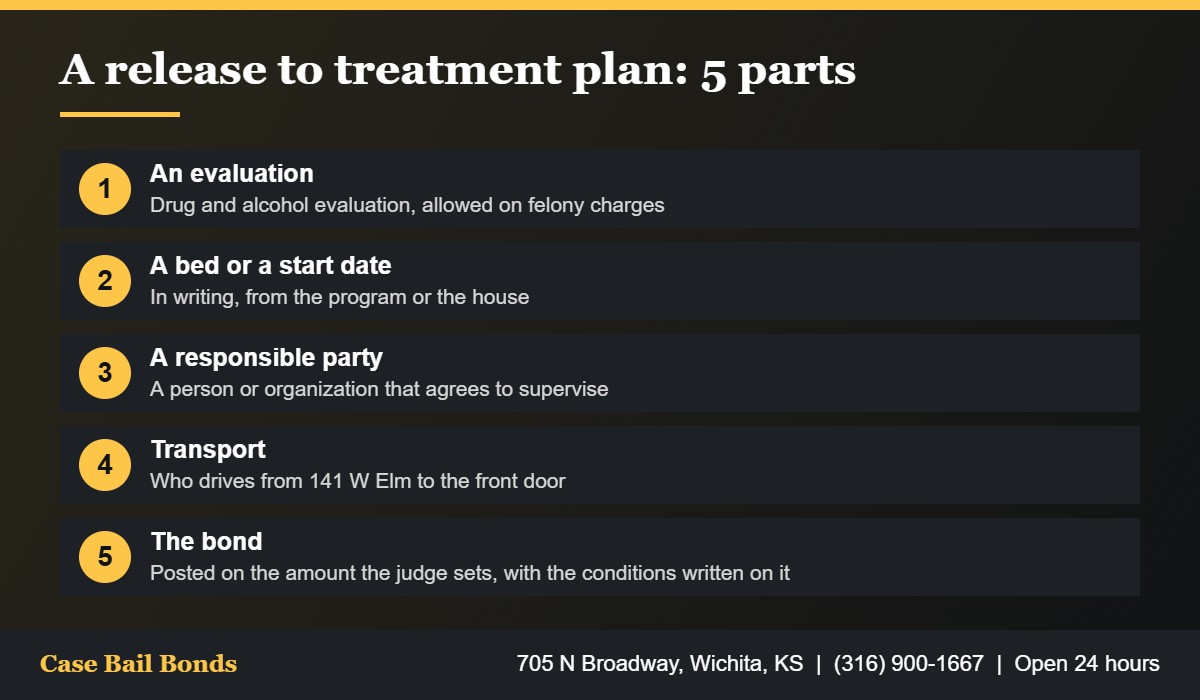
A judge cannot order release to a place that has not agreed to take the person. A plan answers five questions.
1. Has the person been evaluated?
An evaluation says what level of care fits: inpatient, intensive outpatient or outpatient with sober housing. On a felony, the judge can order one as a condition of release.
2. Is there a bed or a start date?
Get it in writing from the program or the house: a letter or an email with the person’s name, the date and the address. A plan that says the family will look for a place is not a plan.
3. Who is responsible?
The statute speaks of a designated person or organization agreeing to supervise. That can be the program. It can also be a parent who agrees to report problems. The judge will want a name.
4. How does the person get there?
A release from 141 W Elm can come at any hour. Decide who is driving from the jail to the front door, and go straight there. Do not stop on the way.
5. What about the bond?
Treatment is a condition. It usually does not replace the bond. The judge may release the person on their own recognizance to a program, or may set a lower bond with treatment as a condition. If a bond is set, it still has to be posted.
| Bond | Minimum premium | Minimum due before posting |
|---|---|---|
| $1,000 | $100 | $50 |
| $2,500 | $250 | $125 |
| $5,000 | $500 | $250 |
| $10,000 | $1,000 | $500 |
Kansas law sets those minimums. More amounts are in how much a bond costs in Kansas.
What a sober living house expects
Sober living is housing, not treatment. Residents live with others in recovery and follow house rules. When a judge makes it a bond condition, the house rules become court rules. Typical expectations:
- No alcohol or drugs, with testing
- A curfew
- Meetings or outpatient treatment
- Rent paid on time
- Work or a job search
Ask the house two questions before the hearing. Will they accept someone with a pending case? Will they tell the court or the bondsman if the person leaves? A judge may ask.
What happens if the person leaves treatment?
Leaving a program or a house named in the bond is a violation of the bond.
| Event | What can follow |
|---|---|
| Walks out of treatment or is discharged for breaking rules | The court can revoke the bond under K.S.A. 22-2807. A warrant is issued and a new bond is set after arrest |
| Fails a drug test | A violation. The judge may tighten conditions or revoke |
| Misses court | The bond is forfeited and a warrant issues |
| Bondsman loses contact | The bondsman can surrender the person to the jail under K.S.A. 22-2809 |
A premium already paid is not credited toward a new bond. The cosigner stays responsible the whole time. Read bail bond cosigner responsibilities and can a bondsman revoke your bond.
If a relapse happens, the best move is to call the lawyer and the bondsman before the court hears about it from someone else. A person who asks for a higher level of care is in a far better position than one who disappears.
Treatment after the case, not just before it
What a person does on bond can shape the outcome. Kansas has two routes that reward it.
- Treatment in place of prison. K.S.A. 21-6824 lets a judge sentence eligible people convicted of felony possession to a certified drug treatment program for up to 18 months.
- Sedgwick County Drug Court. The county describes it as an 18 to 24 month program for felony offenders who were unsuccessful on probation because of a substance use disorder, with frequent court contact and mandatory testing.
A record of staying in treatment while on bond is the kind of fact a defense lawyer can use at sentencing.
For families
- Carry naloxone. A person leaving jail has lower tolerance, and that raises the risk of overdose. See free Narcan kits in Wichita.
- If someone is in crisis, call or text 988, the national Suicide and Crisis Lifeline.
- Do not cosign unless you believe the person will stay in the program. You are guaranteeing the bond with your own money.
- More local help is on our community resources page.
Frequently asked questions
Can a judge order rehab as a condition of bond in Kansas?
Yes. K.S.A. 22-2802 allows release to an organization that agrees to supervise the person, and an evaluation on felony charges.
Does going to treatment replace the bond?
Not usually. It is a condition added to a bond or to release on a signature.
Who pays for treatment ordered as a bond condition?
The person, their insurance or a funding program. Ask the provider before the hearing.
Can someone go straight from jail to a treatment bed?
Yes, when the order and transport are arranged in advance.
What if no bed is available?
Ask the provider for a written start date, and ask the lawyer whether the judge will accept outpatient care with sober housing until then.
Call Case Bail Bonds
We are a family owned company run by Tyson and Rachel Case. We are open 24 hours at 705 N Broadway, Wichita, KS 67214. Call (316) 900-1667.
Sources
- K.S.A. 22-2802, release before trial and conditions, Kansas Office of Revisor of Statutes
- K.S.A. 22-2816, supervised release
- K.S.A. 21-6824, certified drug abuse treatment programs
- Sedgwick County Department of Corrections, criminal justice alternative programs
- Sedgwick County District Attorney, criminal drug diversion guidelines
This article is general information checked against the sources above in October 2026. It is not legal or medical advice.