

Bail is defined as a conditional release mechanism that allows a defendant to remain free before trial in exchange for a financial or personal guarantee of future court appearance. Judges set bail primarily to serve two purposes: securing the defendant’s presence at all scheduled court proceedings and protecting the safety of the community. Bail is not a form of pretrial punishment. Understanding why judges set bail, and how that process works in practice, is foundational knowledge for any law student or legal professional working within the criminal justice system.
Why judges set bail and what it actually accomplishes
The judicial decision to grant bail rests on a specific legal framework, not judicial discretion alone. At the federal level, 18 U.S.C. § 3142(g) requires judges to weigh four categories holistically: the nature and circumstances of the offense, the weight of the evidence, the defendant’s history and characteristics, and the danger the defendant poses to any person or the community. No single factor controls the outcome. This structure reflects a deliberate legislative choice to prevent bail from becoming either automatic or arbitrarily punitive.
The Eighth Amendment to the U.S. Constitution reinforces this framework by prohibiting excessive bail. Courts interpret this to mean that bail amounts must be reasonably necessary to achieve legitimate objectives such as court appearance and public safety, not to serve as a financial penalty. The Supreme Court addressed this directly in United States v. Salerno (1987), upholding the Bail Reform Act of 1984 and confirming that pretrial detention based on danger to the community does not violate due process when procedural safeguards are in place.

Bail hearings are typically fast and involve limited evidence. Judges rely heavily on statutory factors and arguments from prosecution and defense rather than full evidentiary presentations. This compressed format makes the quality of defense advocacy at the bail stage disproportionately important.
What factors do judges consider when setting bail?
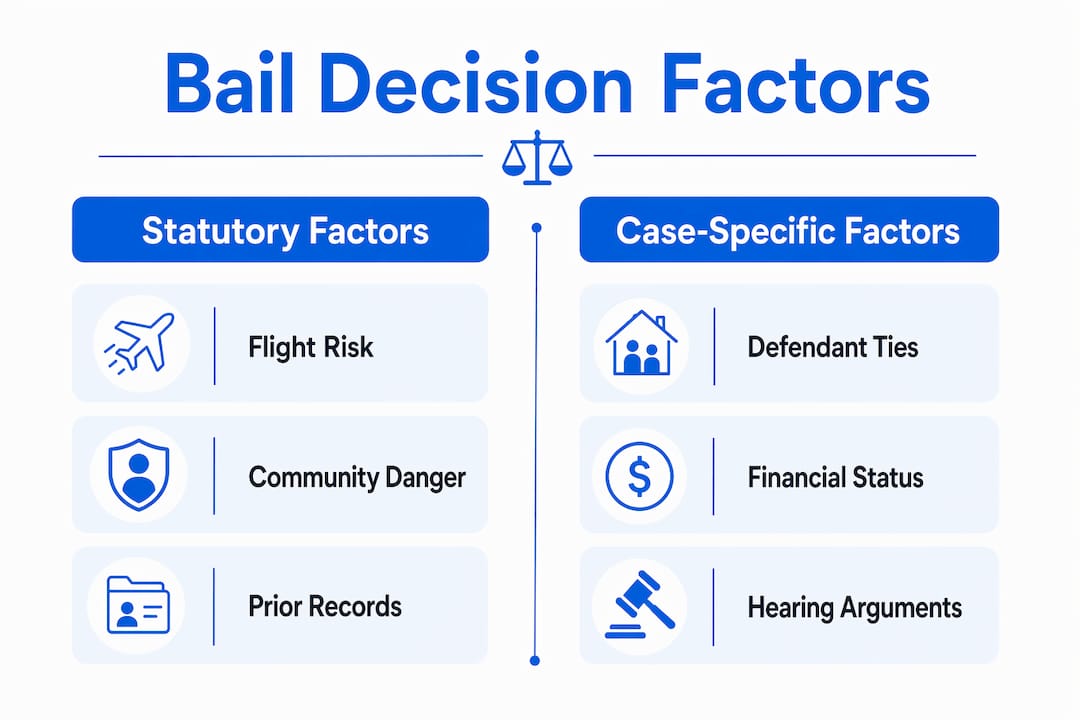
The bail determination factors judges apply are both statutory and case-specific. Pennsylvania Rule of Criminal Procedure 523 provides one of the most detailed statutory lists in the country, and it reflects what most jurisdictions require in practice. Statutory bail criteria include the nature of the offense, weight of the evidence, community ties, employment status, financial resources, mental health history, prior criminal conduct, and danger to the community.
Judges evaluate these factors as a composite picture of the defendant’s risk profile. A defendant charged with a nonviolent property offense who has stable employment, a permanent address in the jurisdiction, and no prior failures to appear presents a very different risk profile than a defendant charged with a violent felony with multiple prior bench warrants. The same charge can produce dramatically different bail outcomes depending on these individual circumstances.
Key factors judges assess in every bail hearing include:
- Nature and severity of the offense: Violent offenses, weapons charges, and offenses carrying mandatory minimums signal higher risk and typically result in higher bail or detention.
- Weight of the evidence: Strong physical evidence or recorded admissions increase the likelihood of conviction, which in turn increases flight incentive.
- Criminal history and prior conduct: Prior convictions, prior failures to appear, and prior bail violations are among the most predictive factors judges use.
- Community ties: Length of residence, family relationships, employment, and local property ownership all reduce assessed flight risk.
- Mental health and substance use: Active untreated conditions may increase risk of noncompliance and can support requests for treatment-based release conditions.
- Danger to others: Specific threats, protective orders, or patterns of violence shift the analysis toward detention or highly restrictive conditions.
Pro Tip: When analyzing a bail decision for academic or professional purposes, map each factor from the statutory list to the judge’s stated reasoning. Gaps between the statutory checklist and the judge’s oral findings often reveal where the decision is most vulnerable to appeal or modification.
How do bail schedules work vs. individualized bail determinations?
Bail schedules are predetermined tables that assign standard bail amounts to specific charges. They function as operational starting points during initial appearances, particularly in high-volume arraignment courts where judges process dozens of cases per session. However, bail schedules are a guide, not binding. Judges may raise, lower, or waive bail based on individual circumstances.
The distinction between schedule-based and individualized bail matters significantly in practice. Florida’s procedural rules illustrate this well. Under Florida Rule of Criminal Procedure 3.131, courts must set a specific bail amount for each charged offense separately and must apply a graduated approach that starts with the least restrictive release option before moving to monetary bail or detention. This means a judge cannot simply apply a schedule amount and move on. The rule requires an affirmative finding that less restrictive conditions are insufficient.
The table below compares how schedule-based and individualized bail determinations differ in practice:
| Factor | Bail schedule | Individualized determination |
|---|---|---|
| Basis for amount | Charge category | Charge plus defendant-specific risk factors |
| Judicial discretion | Minimal at initial appearance | Full discretion required by statute |
| Release conditions | Monetary only | Monetary, non-monetary, or personal recognizance |
| Modifiable | Yes, at hearing | Yes, on motion or at review |
| Jurisdictional example | Most states for first appearance | Florida Rule 3.131, Pa.R.Crim.P. 523 |
Non-monetary release conditions are a critical and often underused tool. Electronic monitoring, travel restrictions, mandatory check-ins with pretrial services, no-contact orders, and substance abuse treatment requirements can all substitute for or supplement cash bail. These conditions allow release while managing specific identified risks.
Pro Tip: If you are advising a client before a bail hearing, document every community tie in writing before the hearing date. Judges working through a crowded docket respond to concrete, verifiable facts. A letter from an employer confirming active employment carries more weight than a verbal representation from counsel.
What constitutional safeguards protect defendants from excessive bail?
The Eighth Amendment’s prohibition on excessive bail is the foundational constitutional protection in this area. Legal standards require bail to serve legitimate objectives rather than punish defendants before any finding of guilt. Courts have consistently held that bail set at a level the defendant cannot possibly pay, when a lower amount would equally secure appearance, crosses into excessive territory.
The Bail Reform Act of 1984 codified procedural safeguards at the federal level that many states have adopted in modified form. These include:
- The right to a detention hearing: Defendants facing potential pretrial detention have the right to a hearing with counsel present before a judge can order detention.
- Written findings requirement: Federal judges must issue written findings of fact and a written statement of reasons when ordering pretrial detention.
- Right to appeal: Detention orders are immediately appealable, and defendants may seek review of bail conditions at any point during the pretrial period.
- Consideration of financial ability: Courts must consider whether a defendant can actually afford the bail set. Bail that functions as de facto detention because of a defendant’s poverty raises constitutional concerns under equal protection principles.
The Salerno decision established that the government’s interest in community safety can justify pretrial detention without violating due process, but only when the statutory procedures are followed precisely. Courts that skip required findings or fail to consider less restrictive alternatives create reversible error. For law students, Salerno is the essential case for understanding where the constitutional floor sits in bail jurisprudence.
How do judges balance public safety, flight risk, and defendant rights?
The judges bail decision process on competing interests follows a structured hierarchy. Judges impose a hierarchy of conditions moving from personal recognizance at the least restrictive end, through unsecured bonds and non-monetary conditions, to cash or surety bonds, and finally to pretrial detention. The judge’s task is to identify the lowest rung on that ladder that adequately addresses the identified risks.
Flight risk and danger to the community are analytically distinct inquiries, though they often overlap. A defendant may pose minimal flight risk but significant danger, or vice versa. A white-collar defendant with deep community ties and no prior record may be a low flight risk but face detention if charged with an offense that carries a presumption of detention under federal law. Conversely, a defendant with prior failures to appear on minor charges may face high bail not because of danger but because of demonstrated unreliability.
Federal pretrial services reports provide judges with structured assessments covering community ties, employment, finances, prior record, and specific risk recommendations. These reports are not binding, but judges rely on them heavily in federal court. State courts vary widely in whether pretrial services exist and how formal their reports are.
Prior failures to appear and bail violations carry more predictive weight than abstract character evidence. A defendant who appeared at every prior court date for ten years presents a fundamentally different risk profile than one with three bench warrants in the past five years, regardless of how many character witnesses either can produce. Compliance history is the most objective data point available to a judge at the bail stage, and courts treat it accordingly.
Some jurisdictions apply reverse onus rules for serious charges. In Ontario, for example, accused persons must show cause for their own release when charged with serious offenses, shifting the burden away from the prosecution. While this applies in Canadian law rather than U.S. federal practice, several U.S. states apply analogous presumptions of detention for charges like murder, drug trafficking, or repeat violent offenses. Understanding these jurisdictional variations is necessary for any practitioner working across state lines.
Key takeaways
Judges set bail through an individualized, constitutionally constrained process that weighs flight risk, community danger, and defendant characteristics against the least restrictive release conditions available.
| Point | Details |
|---|---|
| Bail’s core purpose | Bail secures court appearance and community safety. It is not pretrial punishment. |
| Four statutory factors | Federal law under 18 U.S.C. § 3142(g) requires holistic review of offense, evidence, history, and danger. |
| Schedules are starting points | Judges must individualize bail beyond schedule amounts, as required by rules like Florida’s Rule 3.131. |
| Compliance history is decisive | Prior failures to appear predict future conduct more reliably than character testimony. |
| Constitutional floor | The Eighth Amendment and United States v. Salerno set firm limits on punitive or excessive bail. |
What practitioners and students consistently miss about bail hearings
Bail hearings are the most consequential and least prepared-for proceedings in criminal practice. After years of observing how these decisions unfold, the pattern is consistent: defense counsel who treat the bail hearing as a formality lose clients to pretrial detention that was entirely preventable.
The compressed timeframe is real. Judges handling morning arraignment calendars may spend fewer than ten minutes on each case. That constraint does not reduce the stakes. It increases the premium on preparation. Defense counsel who arrive with a written summary of community ties, an employer letter, and a proposed release plan with specific conditions give the judge something concrete to work with. Judges facing a crowded docket will often accept a well-structured defense proposal rather than spend time constructing conditions themselves.
The other persistent misconception is that bail is primarily about the charge. The charge matters, but defense strategies that reframe statutory risk factors by presenting stable community ties and minimal flight risk consistently produce better outcomes than arguments focused on the merits of the underlying case. Bail hearings are not mini-trials. The judge is not deciding guilt. The judge is deciding risk. Counsel who argue risk rather than innocence operate in the correct frame.
For law students analyzing bail decisions, the most productive exercise is to identify what the judge did not say. Written bail orders that omit required findings, or oral rulings that skip the least-restrictive-conditions analysis, reveal the procedural vulnerabilities that experienced practitioners exploit on appeal or at modification hearings.
— Virtual
How Casebailbonds helps families navigate bail in Wichita
When a judge sets bail, the financial reality of posting that amount falls on the defendant’s family. Casebailbonds provides 24/7 bail bond services throughout Wichita and Sedgwick County, Kansas, so families are never left waiting through the night after a bail hearing.

We understand that bail amounts can feel impossible, especially when they are set at the initial appearance before full individualized review. Our team offers flexible payment plans designed to ease that financial pressure while your loved one’s case moves forward. Whether you are dealing with a straightforward bond or a complex hearing involving multiple charges, Casebailbonds is a trusted Wichita partner ready to help you act quickly and confidently. Call us any time.
FAQ
Why do judges set bail instead of releasing defendants outright?
Judges set bail because unconditional release provides no mechanism to compel court appearance or address community safety concerns. Bail creates a financial or personal stake that incentivizes defendants to comply with release conditions and appear at all scheduled proceedings.
What is the most important factor in a judge’s bail decision?
No single factor controls the outcome under federal law, but prior compliance history carries significant weight. Courts treat prior failures to appear as strong predictive evidence of future noncompliance, often more so than the nature of the current charge.
Can a defendant challenge a bail amount that seems too high?
Yes. Defendants may file a motion for bail reduction at any point during the pretrial period, and detention orders are immediately appealable. The Eighth Amendment prohibits excessive bail, and courts must consider the defendant’s financial ability when setting the amount.
How does a bail schedule differ from a judge’s individualized bail determination?
A bail schedule assigns standard amounts by charge category and is used as an initial reference. An individualized determination requires the judge to assess the specific defendant’s risk factors and apply the least restrictive conditions necessary, as mandated by rules like Florida Rule of Criminal Procedure 3.131.
What happens at a bail hearing in Wichita, Kansas?
At a bail hearing in Wichita, a judge reviews the charges, the defendant’s background, and arguments from both prosecution and defense before setting bail or release conditions. Families seeking to understand the full process can review the post-arrest process specific to Wichita and Sedgwick County.