To get off a bond you cosigned in Kansas, you have to ask the bondsman to end the bond. You cannot cross your name off the contract or call the court and withdraw. A bond stays in force until the case is over or until the person is back in custody and the bondsman is discharged. As the cosigner, your lever is the bondsman, who has the legal power under K.S.A. 22-2809 to surrender the defendant to the jail. This page walks through how that works in Wichita and what you still owe afterward.
Questions about a bond we wrote? Call Case Bail Bonds at (316) 900-1667. We are at 705 N Broadway, open 24 hours.
On this page
- What a cosigner actually signed
- 4 ways a cosigner’s liability ends
- How to get off a bond: the steps
- What if the defendant already missed court?
- What you still owe after you are off the bond
- Frequently asked questions
- Talk to a bondsman who will give you a clear answer
What a cosigner actually signed
When you cosign, you sign an indemnity agreement with the bail bond company. You are not a party to the criminal case and the judge does not know your name. Your promise is to the bondsman, and it has two parts:
- You will pay the premium, or whatever part of it is still owed.
- If the defendant misses court and the bond is forfeited, you will cover the bond amount and the cost of bringing the person back.
That is why the court cannot take you off the bond. The court holds the bondsman responsible. The bondsman holds you responsible. Our page on bail bond cosigner responsibilities covers this before you sign.
4 ways a cosigner’s liability ends
| How it ends | What happens to your liability |
|---|---|
| The case ends | The court releases the bond. Nothing more can be forfeited |
| The bondsman surrenders the defendant | The bondsman is discharged, so there is nothing left for you to guarantee going forward |
| A judge revokes the bond | The old bond ends when the warrant is served. A new bond needs new signatures |
| The defendant is jailed on something else and the bond is released | Ask the bondsman to confirm in writing |
In every case, money already owed stays owed. Ending the bond stops future risk. It does not erase the premium balance or any costs the contract lets the company charge.
How to get off a bond: the steps
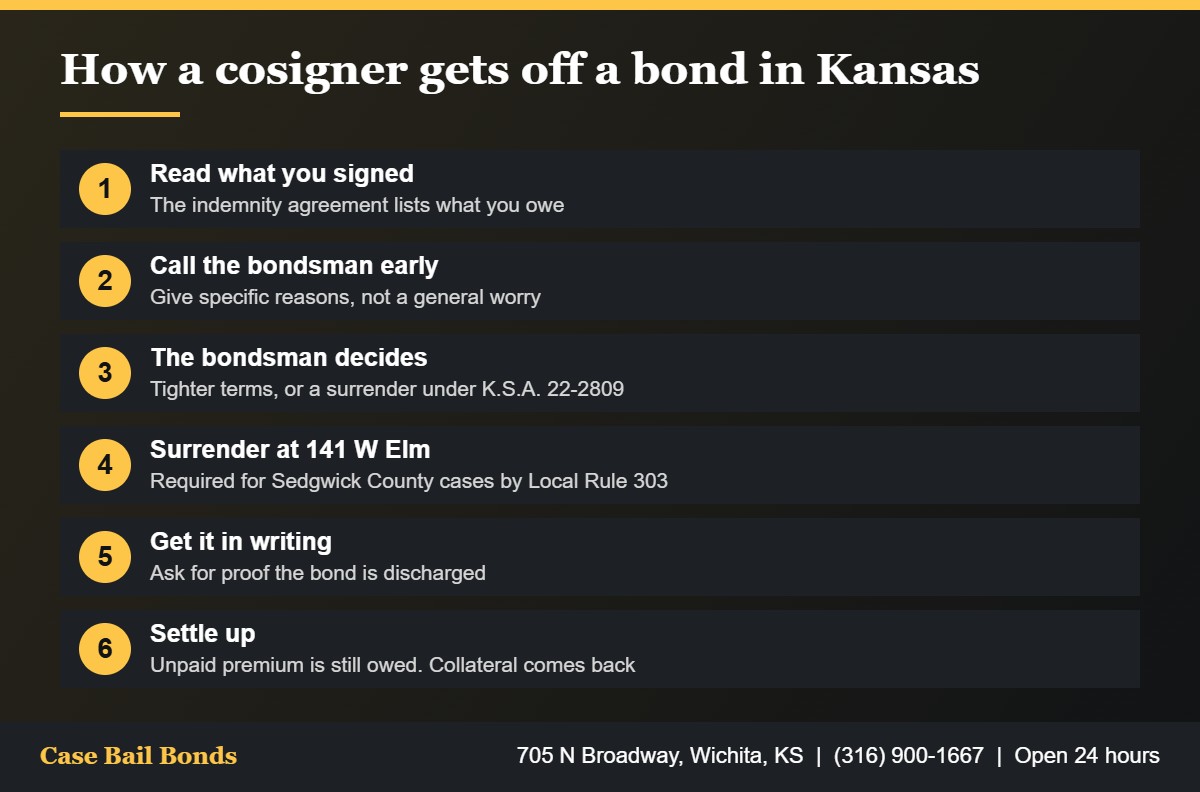
- Read the contract. Find the sections on surrender, fees and collateral. Some contracts charge the cosigner a surrender fee or recovery costs.
- Call the bondsman as soon as you have a real concern. Be specific. “He told me he is moving to Tulsa.” “She has missed two check ins and changed her number.” “He did not come home after court.” Specific facts get action.
- Let the bondsman decide. The bondsman may tighten the terms first, with more check ins, a new address on file or GPS monitoring. Or the bondsman may surrender the defendant.
- Surrender. Under K.S.A. 22-2809 the surety arrests the person and delivers them to the county jail, then gives a judge a sworn statement of the reasons. For a Sedgwick County case, Local Rule 303 says the surrender must be made at the Sedgwick County Adult Detention Facility, 141 W Elm. A surrender in another county or state does not count.
- Get written confirmation. Ask for something that shows the bond is discharged and the date.
- Settle the account. Pay what is owed and ask for your collateral back. K.S.A. 22-2809b treats intentionally failing to return collateral when due as grounds to suspend a bondsman’s authority.
Know what you are asking for. A surrender puts the defendant back in jail. They will need a new bond, a new premium and probably a new cosigner. Do it when you believe they will not go to court. Do not do it over an argument.
What if the defendant already missed court?
Then time matters more than anything. Here is the timeline in Kansas law.
| Step | Timing |
|---|---|
| Bond declared forfeited and warrant issued | At the missed court date |
| Failure to appear becomes its own crime | If the person does not surrender within 30 days of forfeiture (K.S.A. 21-5915) |
| Earliest a court can enter judgment on the bond | More than 60 days after notice (K.S.A. 22-2807) |
| Partial refund after judgment if the person is returned | 90% within 90 days, 75% within 91 to 180 days, 50% within 181 to 270 days |
A court can also set a forfeiture aside before judgment. One ground in K.S.A. 22-2807 is proof that the defendant was in jail somewhere in the United States.
For a cosigner this means one thing: help get the person back in front of the judge fast. Tell the bondsman everything you know, including phone numbers, where they work, a girlfriend’s apartment off South Seneca or a cousin’s place in Newton. If the person goes back before a judgment is entered, you may owe little beyond costs. Read more in what happens when you miss court on bond and failure to appear in Kansas.
What you still owe after you are off the bond
- Unpaid premium. Kansas sets the minimum premium at 10% of the bond, and it is earned when the bond is posted. A surrender does not cancel the balance.
- Costs in the contract. Recovery or surrender fees, if you agreed to them.
- Nothing on future court dates. Once the bondsman is discharged, there is no bond left to forfeit.
Collateral, such as a car title or a deed, should be returned once the bond is discharged and the account is settled. See bail bond collateral in Kansas.
Frequently asked questions
Can a cosigner be removed from a bail bond?
Not by request alone. A bondsman may agree to replace you with another qualified cosigner, but does not have to. Otherwise your liability ends when the bond ends.
Can a cosigner go to jail if the defendant runs?
No. Cosigning is a civil promise to pay. You can be sued for the money and lose collateral, but you are not charged for the defendant’s failure to appear. Hiding the person or lying to help them avoid arrest is a different matter and can be a crime.
What happens if I do not pay the bail bond company as a cosigner?
The company can use your collateral and can sue to collect what the contract says you owe.
Will the defendant know I asked to get off the bond?
Assume yes. The bondsman gives a sworn statement of the reasons for the surrender.
Can I get off a bond if I just changed my mind?
You can ask. The bondsman decides, and the contract controls what it costs you. It is far easier to say no before you sign. Our list of questions to ask a bail bond company helps with that.
Does it matter that the defendant is on a payment plan I agreed to?
Yes. You guaranteed those payments. See how bail bond payment plans in Wichita work.
Talk to a bondsman who will give you a clear answer
Case Bail Bonds is a family owned Wichita company run by Tyson and Rachel Case. Call (316) 900-1667 or visit 705 N Broadway, Wichita, KS 67214. For the bondsman’s side of this, read can a bondsman revoke your bond.
Sources
- K.S.A. 22-2809, surrender of obligor by surety, Kansas Office of Revisor of Statutes
- K.S.A. 22-2807, forfeiture of appearance bonds
- K.S.A. 22-2809b, compensated sureties
- K.S.A. 21-5915, failure to appear
- 18th Judicial District Court, local court rules, Rule 303
This article is general information checked against the sources above in October 2026. It is not legal advice.